Showing posts with label bulk Ethernet cable. Show all posts

Saturday, February 4, 2017

Understanding Bulk Ethernet Cable: Stranded or Solid Ethernet Cable

There are a dizzying number of bulk Ethernet cable type available on the market, corresponding to a array of standards detailing the configuration and performance specification needed to support the increasingly faster data rates and larger bandwidths of incoming technologies. Of which stranded and solid Ethernet cables are the commonly used cable types when purchasing bulk Ethernet cable. These two different types refer to the internal conduction inside the bulk Ethernet cable. Today’s article provide the detail information about these two copper network cables.
Stranded and Solid Ethernet Cable
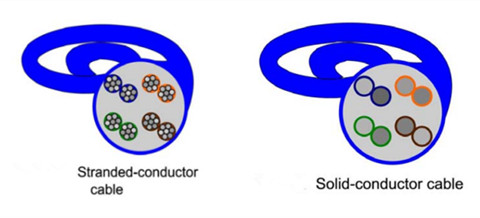
Stranded Ethernet cable has multiple smaller strands of wires that are twisted together to form a single conductor. And a solid Ethernet cable is just fabricated with a single solid strand of copper for each of the 8 conductors. Figure 1 shows the inner structure of the stranded and solid Ethernet cable.
stranded or solid ethernet cable
From the above picture, we can see that each of the conductors inside a solid Ethernet cable is made up of a single, solid conducting wire with diameters between 22 and 24 AWG. Take cat6 bulk cable as an example, it employs the larger 23 AWG copper wires, which makes it better suited to new and emerging fast Ethernet applications (than cat5 bulk Ethernet cable). However, owing to the fragility of their conducting wires, the solid Ethernet cables are well-packed inside a strong outer sleeves that resists bending making them less flexible and not well suitable to normal everyday use in connecting work area component.
However, stranded Ethernet cable is the one that we most often work directly with. Unlike the solid Ethernet cable, the stranding of the wire conductors serves to protect them, and provide stranded cables their flexibility. For a given conductor length, the more times each strand twists around the central conductor, the better the protection and greater the overall flexibility of the cable. Because of their internal difference, each of the cable types might be suitable for a specified situation.
Choosing for Backbone and Horizontal Cabling
Installing any bulk Ethernet cable type (solid or stranded Ethernet cable) into a building’s structure should be well managed by keeping long-term applications in mind. Solid Ethernet cabling with its superior electrical performance and longer runs makes it more suitable for permanent building installations. Additionally, its stability over higher frequencies means that longer time periods are possible between cable reinstallations, and its comparative frailty is not a problem when it is protected from damage by the building itself. Since solid Ethernet cable is most often used for these permanent cabling applications, it often referred to as network cable.
For horizontal cabling, solid Ethernet cables are also used spanning the distances between telecommunications rooms and work areas. In addition to performing better over long distances and at higher frequencies, the single, larger conducting wires of solid cables are much easier to terminate than the multiple fine wires of stranded conductor cables. Also, the relative stiffness of solid cable makes it preferable for use with punch down connectors on the backs of wall jacks. In contrast, the softness and flexibility of stranded Ethernet cables make working with punch down connectors or IDCs (Insulation Displacement Connectors) very difficult.
In conclusion, there is very little difference between the electrical performance of solid and stranded cables for very short lengths (below 10 meters). In modern hierarchical wiring schemes, the length limitations of stranded cables are easily met (3 m, or 9.8 ft), and the increased flexibility and durability of stranded cables make them perfectly suited for interconnecting work area outlets with workstation PCs and other end-user devices.
However, solid cables are far too fragile for frequent bending and handling, and far too difficult to manage in connecting closely spaced components. The conductors inside a stranded cable are protected by the wire strands surrounding them, so that very little of the conducting surface area is exposed to damage if the cable is accidentally cut or smashed, and the conductor is not weakened by repeated flexing and bending. Without this protection, the conducting surfaces within a solid-conductor cable are more susceptible to nicks or other irregularities that affect transmission performance and often accompany their early demise.
Conclusion
As we move toward increasingly faster Ethernet systems, the copper transmission medium would require increasingly faster frequencies and data rate. For solid and stranded cables, the differences seen in electrical activity are very little. FS.COM offers a full range of bulk Ethernet cables including the cat5 bulk cables, cat6 bulk cables, cat7 bulk cables, and copper cable assemblies. If you have any interest, please contact us.

Thursday, December 29, 2016

Why Should We Keep Fiber Optic Connectors Clean?

Fiber optic technicians are aware that dirty connections can cause attenuation, but they may not realize that it can also cause bit errors or slowdown of the network. Therefore, keeping the fiber optic connector endfaces clean is one of the most overlooked aspects of fiber optic maintenance and troubleshooting. Today’s article will describe the detailed information about how dirty fiber optic connector can cause slowdown of the network.
Brief Overview of Fiber Optic Connectors
A fiber optic connector is urgently needed to the industry owing to the lower loss, lower cost, easier to terminate or solved some other perceived problem. As a result, about 100 fiber optic connectors have been introduced to the marketplace, but only a few represent the majority of the market. Commonly used fiber optic connector types like the SC, FC, LC, ST, MU, E2000, MTRJ, SMA , DIN as well as MTP & MPO etc, which are widely used in the termination of fiber optic cables, such as fiber optic pigtail, fiber optic patch cables and so on.
How Does the Dirty Fiber Optic Connector Cause Bit Errors?
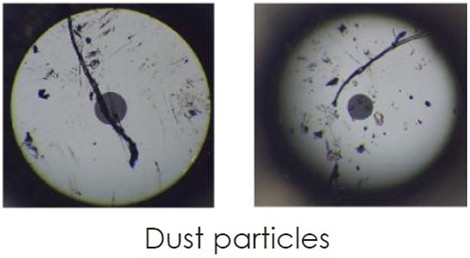
Of course, the dirty fiber connection will cause bit errors as the contamination degrades the signal quality. In fact, the signal comes in a beam of light traveling through the fiber’s core. When the light travels through the fiber core, it has a refractive index value. But when the light beam comes into contact with end face contamination, it will enter a second medium which has different refractive index value. That’s the reason why it causes the bit error rates.
fiber-conn-dust
Figure 1: dust particles under the microscope
Sometimes, in fiber optic network, we need to mate two fiber optic connectors together. Will the mating prevent fiber optic connector from contamination? The answer is yes. There is no need to worry about dust with physical contact connectors as long as they were cleaned before the mating process. When the two ferrules are physically mated, the mating force for most single fiber industry standard connectors is around 1kg or about 2.2lbs. If you calculate the force of what 2.2lbs in a 200μm, that comes to 45,000psi which is why contaminate migration is not a problem even in a dusty environment. The following part will provide some answers to some common questions of end users.
Will the Dust Cap Make Fiber Endface Clean?
No, customers should never assume that a capped cable assemblies is clean when taking out of the bag. Dust and mold release agents are the two common contaminates but nearly invisible for the human eyes. The primary purpose of the end cap is to protect the ferrule end face from scratch and pitting defects. It does not protect the ferrule end face from contamination.
If a customer buys a new fiber jumper from the manufacturer and inspects it after taking the end caps off, it would not be uncommon to see some small amount of on contamination on the endface. This does not mean that the jumper manufacturer’s quality process are lacking. All manufacturers experience this. The customer just needs to work smartly and realize that the end cap is just for protecting against scratches. The best practice is to inspect the ferrule, clean if necessary and re-inspect before mating. If the customer does not have a ferrule scope available, then cleaning both connectors end faces before mating will significantly reduce the likelihood of damage and cross contamination.
How to Keep the Fiber Optic Connectors Clean?
Keeping fiber connections clean is different from any other type of cleaning due to the relative sizes of the connectors compared to the particles and contaminants that typically reside on them. Also we need to be diligent in their maintenance by cleaning the connectors every time before they are mated and after each un-mating. Static charges attract dust to the fiber connectors and prevent them from falling off even when blown with a can of compressed air. As we have discussed in the above article, dust caps are primarily used to protect the ferrule and can actually make a clean connector dirty due to their tendency to keep a static charge.
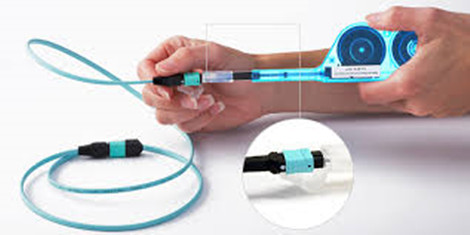
one-click-cleaner
Figure 2: use one-click cleaner to clean the MPO cable
The mechanical cleaning tools like the One-Click cleaners are widely used in the optical fields. . One-click cleaner is designed to clean male connectors, female bulkhead adapters, fiber patch cables and test equipment. It cleans the ferrule endface removing from dust, oil and other contamination without scratching the endface. Although it is the most cost-effective and time-saving solution for cleaning fiber optic connectors, it has a limited contact region and will never be able to clean the connector’s end face. Therefore, another fiber optic cleaner has given to birth—Fiber Optic Cassette Cleaner. The cassette cleaner can wipe away contamination from optical connector endface with ease. I’s very easy to use and suitable for LC/MU/SC/FC/ST/MPO/MTRJ connectors. Usually, the body of this cleaner is made from antistatic materials which will not produce dust.
Is Dry Cleaning a Better Solution?
Besides the mechanical cleaning tools, there are two basic methods :dry cleaning and wet cleaning. There are two distinct advantages a wet cleaning process has over the dry process. The first process is static dissipation and the second is the cleaning solvent’s ability to loosen up harden contaminates from the ferrule end face without causing permanent defects to the end face.
On the other hand, the dry wiping process that an operator would do using a Fiber Optic Cassette Cleaner or One-Click cleaner relies on contact friction to remove contamination. When two materials are rubbed together, there is a transfer of electrons between the two surfaces and the imbalance on the surface creates a charged electric force we call static electricity. The two surfaces, one charged positive and the other negative, will try to pull in surrounding particles to being the charge back into a neutral balance. This attraction pulls in the dust particulates in the air and the wear debris on the connector body and adapter. The introduction of a cleaning solvent during a wet-dry cleaning process introduces static dissipative medium for the charge so that it does not stay on the ferrule surface.
Conclusion
End users should be wise to think of the environment his connectors are being exposed before learn to keep fiber optic connector clean. Because a large enough piece of dust particulate residing somewhere on either ends will create problems. The best practice to avoid long-term problems and extend the life of your optical assemblies is to always inspect and remove any contamination regardless of the connector type. FS.COM offers a full range of fiber optics that can cater to your specific requirement. Bulk Ethernet cable, fiber jumpers, transceivers  and DAC/AOC cables are in great selection. Please feel free to contact us.