Showing posts with label QSFP-40G-SR4. Show all posts

Thursday, October 13, 2016

Migrate to 40G Ethernet With SMF&MMF 40G QSFP+ Transceiver

Due to the server consolidation, virtualization, and performance improvements, data center designers are eager to migrate from 10G to 40G to better meet their network demand. However, there are many 40G optical transceivers and cabling solutions available for sale, such as QSFP-40G-SR4, QSFP-40G-LR4, QFX-QSFP-40G-ESR4, as well as QSFP DAC/AOC cables. So, which one is the most cost-effective solution? No one can give you an exact answer without the detailed information. The above 40G optical transceivers and cables have already been introduced in the previous articles. Today, I am about to shed light on a new QSFP optical transceiver—SMF&MMF 40G QSFP+ (QSFP-40G-UNIV) and its function in 40G migration.
What Is SMF&MMF 40G QSFP+ Transceiver?
The typical fiber optic transceiver may either operate on multimode fiber or single-mode fiber. For example, the Cisco QSFP-40G-SR4, QSFP-40G-LR4 can only operate over multimode fiber for up to 150m, and single-mode fibers with a link length of 10km, respectively. However, a SMF&MMF 40G QSFP+ transceiver as the name implies, can be used with both multimode and single-mode fibers without the need for any software/hardware changes to the transceiver module or any additional hardware in the network. This is usually accomplished (seen in Figure 1) by combining four 10G optical channels at different wavelengths (1270, 1290, 1310, and 1330 nm) inside the transceiver module to transmit and receive an aggregate 40G signal over a single pair of multimode or single-mode fibers.
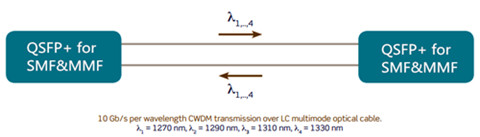
working-principle-of-smfmmf-40g-qsfp-transceiver
40GBASE-UNIV and 40GBASE-LX4 QSFP+ Transceiver Overview
Vendors like Huawei, Arista, H3C and Cisco all offer QSFP-40G-UNIV optical transceivers. Based on IEEE 40GBASE-LR4 specifications, QSFP-40G-UNIV operates in the 1310nm band. It uses a duplex LC connector and supports distances up to 150 m over OM3 or OM4 multimode fiber and up to 500 m over single-mode fiber (different vendor may have different specifications). Besides the QSFP-40G-UNIV transceivers, 40GBASE-LX4 QSFP+ transceiver is the other type of the SMF&MMF 40G QSFP+. Take Juniper JNP-QSFP-40G-LX4 as an example, the Juniper 40 Gbps LM4 QSFP+ optical transceiver, part of the Juniper family of optical transceivers, is optimized to fully leverage 40 Gigabit Ethernet (GbE) switches and routers. Figure 2 shows FS.COM SMF&MMF 40G QSFP+ transceiver solutions.
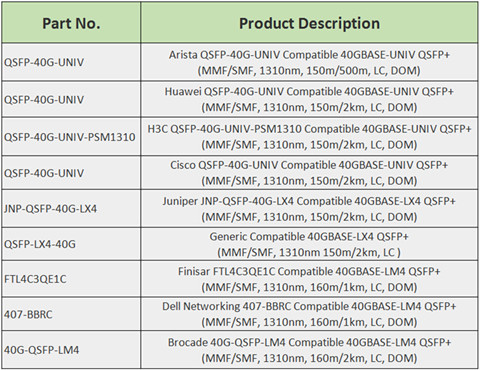
smfmmf-40g-qsfp-transceiver
Why Should We Use SMF&MMF 40G QSFP+ Transceiver to Achieve 40G Migration?
With the increase in data center bandwidth requirements, migration to 40G for switch to switch connections is in higher demand. SMF&MMF 40G QSFP+ transceiver is designed to allow for seamless migrations from existing 10G to 40GbE networking without requiring a redesign or expansion of the fiber network. Besides, this transceiver also provides a cost-effective solution to migrate from multimode to single-mode fiber, allows a single-mode fiber infrastructure for distances up to 500m. The following part presents the unique merits of SMF&MMF 40G QSFP+ transceiver.
  • Upgrade to 40G Without Additional Cables
The existing QSFP+ transceiver like QSFP+ SR4, QSFP+ CSR4 and QSFP+ LR4 optics, utilizes four independent 10G transmitters and receivers for an aggregate of 8 cables for 40G links. Therefore, customers have to add additional fiber to increase the number of 40G links. However, a SMF&MMF QSFP+ uses duplex LC connector that is consistent with the existing 10G connections, which are also commonly MMF cables with duplex LC connectors. Therefore, a SMF&MMF QSFP+ allows the same cables to be used for direct 10G connections to direct 40G connections, resulting in zero-cost cabling migration. What’s more, by deploying the SMF&MMF 40G QSFP+ transceiver, customers increase the number of 40G links by 4 times without making any changes to their fiber infrastructure, which greatly expand network scale and performance. Figure 3 shows the difference between QSFP+ SR4 QSFP+ and 40GBASE-UNIV universal modules.
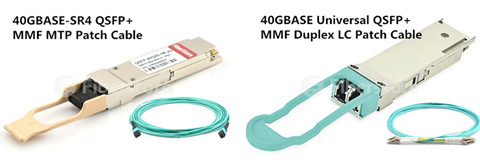
multimode-qsfp-and-smfmmf-40g-qsfp-transceiver
  • Realize the Migration From Multimode to Single-mode Fiber
There is a increasing trend for data center designers to move to single-mode optical solutions due to the distance limitations of the multimode cabling system. When data rates increase from 40G to 100G and beyond to 400G, it is just not that easy to move to single-mode cable system for cost effectiveness. Because network managers needs to replace all the old multimode optical devices into brand new single-mode equipment, which usually costs a large mount of money. However, with SMF&MMF QSFP+ optic module, migrating to 40G and 100G will be simpler. As SMF&MMF QSFP+ interoperates with 10km QSFP-LR4 optics, it s a cost effective solution for SM fiber infrastructure for distances up to 500 m.
  • Simplify the 40G Cabling System
The SMF&MMF 40G QSFP+ transceiver offers the unique advantage of operating on both multimode and single-mode fiber without any requirement for additional hardware or software. Customers can consolidate their optics and use SMF&MMF QSFP + in their network irrespective of the fiber type, which makes full use of the existing cabling systems, reduces the cost of deployment and of support, and simplify purchasing and deployments.
Conclusion
SMF&MMF 40G QSFP+ transceiver offers a cost-effective transition path for migrations to single-mode fiber in data centers with a single transceiver that bridges the gap between multimode and single-mode optics, enabling data centers running at 10G today to seamlessly upgrade to 40G without having to re-design or modify the cable infrastructure. FS.COM offers a full range of 40G optical transceivers and cables that ensure the smooth migration to 40G data center deployments. Products like QSFP-40G-SR4, QSFP-40G-LR4, QFX-QSFP-40G-ESR4, as well as QSFP DAC/AOC cables are well-tested and fully compatible with major brand. The SMF&MMF 40G QSFP+ transceivers are also offered with very competitive price but high quality. Contact us if you are interested.

Sunday, July 17, 2016

How QSFP+ 40GBASE-iSR4 Optics Is Developed

In response to the increasing bandwidth demands facing data centers, network designers are paving the way for the introduction of 40Gbqs operations. Owing to this, telecommunication vendors continuously expand the portfolio of innovative parallel fiber optic transceivers to increase the 40G performance, resulting in 40G QSFP+ transceivers becoming the shining star on the market. 40G QSFP+ 40GBASE-iSR4 optics is the newly evolved products for 40G connectivity, but opportunity always besides with challenges. As people are so concerned about the future of their network, understanding the 40GBASE-iSR4 QSFP+ will be helpful for future high-performance Ethernet needs.
Why Move to 40G Ethernet Network
The volume of digital information flowing through data network develops at an ever increasing rate day by day. So the growth of cloud computing, server virtualization and the trend toward network convergence is forcing today’s networks to be more efficient and faster than ever. 1Gbps Ethernet access links have been replaced by 10Gbps links due to the increases in server utilization obtained through Virtualization. To keep up, higher performance switching hardware is needed to provide sufficient I/O (Input/Output) bandwidth to avoid blocking. In order to meet this demand, many newer access switches could support 48 ports of 10G Ethernet for connection to downstream servers, and 2 or 4 ports of 40G Ethernet for connection to the core switches. These 40G interconnects are implemented by using QSFP+ transceivers and could provide sufficient bandwidth to enable fully non-blocking switch fabrics.
Avago 40G optics
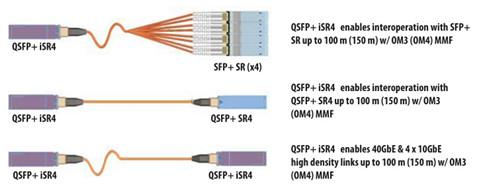
QSFP+ is featured with various advantages like delivering excellent high speed optical/electrical performance coupled with low power dissipation. In addition, with bundled fiber cables and MPO connectors, the port density of QSFP+ modules is triple that of SFP+ modules. Moreover, the power consumption is reduced from 1000 mW maximum per lane for SFP+ to 375 mW maximum per lane for QSFP+. 40GBASE-iSR4 QSFP+ module like AFBR-79EIDZ is not only 40Gb Ethernet compliant, but also inter-operable with any 10GBASE-SR compliant transceiver at link distances up to 100 meters over OM3 multimode fiber. The letter “i” in 40GBASE-iSR4 QSFP+ refers to the ability of inter-operation. AFBR-79EIDZ see in Figure 1 is Avago 40GBASE-iSR4 QSFP+ transceiver available on the market. Just as any other modules, this Avago QSFP+ iSR4 is designed to be fully compatible with the 40GBASE-SR4 specification. It’s capable of inter-operating with legacy 10GBASE-SR transceivers.
40GBASE-iSR4 QSFP+—an Cost-Effective Solution
40GBASE-iSR4 QSFP+ transceiver was released to tackle the issue of an overload condition when connecting a 40GBASE-SR4 transmitter to a 10GBASE-SR receiver. It is intended to be fully compliant to the 40GBASE-SR4 specification but with a lower maximum transmit optical output power. The maximum specified output power has been lowered from +2.4 dBm to -1 dBm allowing it to interface with 10GBASE-SR receivers without fear of overload.
QSFP+ 40GBASE-iSR4 Optics
The VCSEL design combined with superior laser programming and control algorithms allow for a reduction in the module maximum specified optical output power without compromising any of the module high speed electro-optic performance. And the result (see in Figure 2) is a fully compliant 40GBASE-SR4 module like QSFP-40G-SR4 which can interoperate with legacy 10GBASE-SR transceivers. For further understanding of the 40GBASE-iSR4 optics, it is advisable for you to take a glance at the development of it.
Standardization of 40GBASE-iSR4
The release of IEEE 802.3ba-2010 standard for 40G Ethernet specifies the optical and electrical requirements for various physical layer link implementations. The 40GBASE-SR4 PMD (physical medium dependent) variant defines a 4-lane parallel optical interconnect for operation over OM3 multimode fiber with transmission distance up to 100 meters. Each of the four lanes works at a data rate of 10.3125 Gbps which is the same serial bit rate that was defined for 10G Ethernet links.
The 40GBASE-SR4 PMD addresses the need for 40Gbps interconnects in the data center. It takes advantage of the widely-deployed and low-cost 850nm VCSEL (vertical cavity surface emitting laser) technology. Because each of the 4 lanes in 40GBASE-SR4 have the same serial bit rate of 10G Ethernet link, there is an opportunity for switching hardware vendors to utilize 40GBASE-SR4 as 4 separate 10G Ethernet interconnects.
Challenge Hindering the Development
The standard of 40GBASE-SR4 provides an opportunity to further address the growing need for bandwidth. It is not defined to be backward compatible with the preceding 10G Ethernet short reach interconnect standard. Although both 40G Ethernet and 10G Ethernet included a PMD definition for short reach VCSEL based optical links operating at 10.3125 Gbps per lane, interoperability cannot be guaranteed.
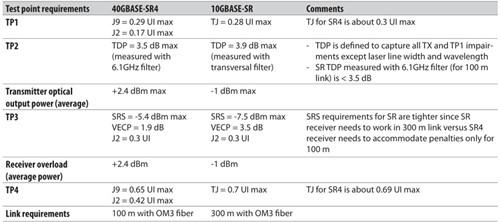
The following analysis of 40GBASE-SR4 and 10GBASE-SR specifications tells why inter-operability cannot be guaranteed over all specified operating conditions.
analysis of 40GBASE-SR4 and 10GBASE-SR specifications
From the above chart, we could see that many of the transmitter and receiver specifications governing the 10GBASE-SR standard are equal or more stringent than those for 40GBASE-SR4 standard. This is not surprising because the 40GBASE-SR4 specification is written to cover transmission links up to 100 meters, while the 10GBASE-SR specification is intended to satisfy a maximum transmission link length of 300 meters over OM3 multimode fiber. Except the distance, the main specification gap preventing guaranteed inter-operability relates to receiver overload.
Summary
40GBASE-iSR4 QSFP+ proves itself as a suitable solution for designers to mount their network capacity. QSFP+ iSR4 optics is able to support standard 40G Ethernet links up to 100 meters over OM3 and 10GBASE-SR links over the same distances. FS.COM offers a variety of 40G QSFP+ modules for you to choose from. The Avago compatible QSFP+ 40GBASE-iSR4 modules are also provided. For more information about Avago QSFP+, you van visit us.

Wednesday, January 27, 2016

Design Consideration for 40G Ethernet Network

With the speed in the data center now increases from 10G to 40G, different optical technology and cabling are required. But at first we should figure out the design of 40G Ethernet network. There are several key factors that may affect the transition to 40G. This article today will pay special attention to those aspects that influence data center design consideration.
General Data Center Design
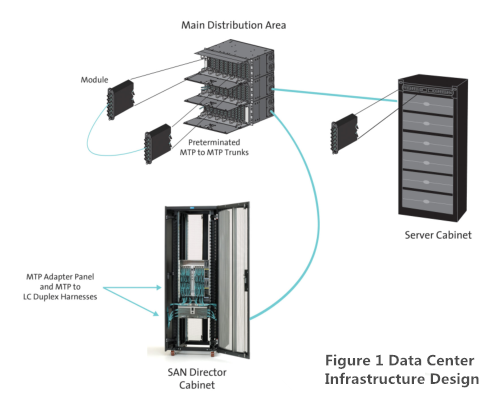
The principal goals in data center design are flexibility and scalability, which involve site location, building selection, floor layout, electrical system design, mechanical design and modularity. Furthermore the key to a successful data center facility: one that is sustainable in the long term; the other is to consider it as a receptacle for equipment and operations, as well as an integrated system, in which each component must be considered to be flexible and scalable. Figure 1 shows a typical data center infrastructure design utilizing preterminated optical solutions.
data center design
What Does MPO Connector Means for 40G Data Center?
While speeds have increased to 40G, optical connectivity has remained in a duplex format, whether SC or LC. With the advent of 40G/100G Ethernet, multi-fiber push-on (MPO) connector technology are now used at the electronics interface and further into the data center infrastructure design. MPO technology has displayed proven value in cassette-based data center physical layer installations.
The MPO is defined by TIA-604-5-C, Fiber Optic Connector Intermateability Standard. Type MPO (FOCIS-5) as an array connector that can support up to 72 optical fiber connections in a single connection and ferrule. While the MPO is versatile in the fiber count supported, the 12-fiber MPO is the version widely deployed. Many data center designs today use cassette-based duplex LC connectivity or MPO to duplex LC harnesses at the electronics interface, while 12-fiber MPO-based connectivity is used to connect the trunk cabling to each cassette or harness.
40G Standard Provision
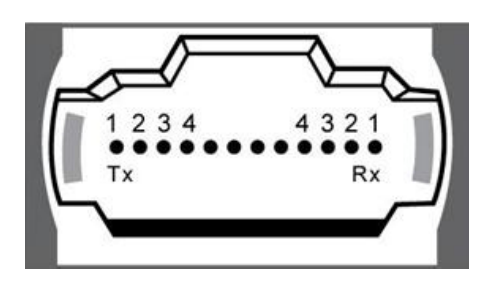
The Habtoor STFA Soil Group (HSSG) has designated 40G to support high-performance computing clusters, blade servers, SANs and network-attached storage. For 40G deployment, the QSFP transceiver will utilize a 12-fiber MPO. Deployment of 40G over multi-mode fiber will be achieved with 4-Tx and 4-Rx fibers from the 12-fiber MPO (see in Figure 2). Each of these four “channels” will transmit 10G for the combined 40G transmission. Single-mode fiber transmission will remain duplex connectivity using course wavelength division multiplexing. The HSSG has also defined the transmission media for 40G to include:
MPO connector
  • 40GBASE-SR4 (parallel optics)
100m on OM3/125m on OM4—10G on four fibers per direction
  • 40GBASE-LR4(cWDM)
10km on single-mode fiber—4x10G 1300nm wavelength region
  • 40GBASE-CR4
7m over copper—4x10G (twinax copper)
  • 40GBASE-FR(Serial)
2km on single-mode—4x10G 1550nm
As noted above, the QSFP+ module is specified for use with different standard. The 40GBASE-SR4 is terminated with the MPO connector. For example, Cisco QSFP-40G-SR4 QSFP+ transceiver enables high-bandwidth 40G optical links over 12-fiber parallel fiber terminated with MPO/MTP multifiber female connectors.
For 12-fiber MPO cassette-based optical systems already installed, 40G migration is as simple as removing the existing cassette from the patch panel housings at the equipment and cross connects and replacing the cassette with an MPO adapter panel. Next, an appropriate 12-fiber MPO jumper would be used to cross-connect the trunk cabling as well as interconnect into the QSFP. Though not widely available currently, future preterminated system trunks may utilize 24-fiber MPO connections, both on the trunks and on the cassette. In this case, 40G deployment would require an interconnect harness terminated with two 12-fiber MPO connectors at the QSFP end, and one 24-fiber MPO at the trunk end. This would provide the needed interface with the 24-fiber MPO-based trunk and the 40G QSFP. A 24-fiber MPO jumper would be needed at the system cross connects to ensure polarity was maintained and that skew was within requirements.
Conclusion
The data center infrastructure must be reliable, manageable, flexible and scalable no matter who you are asking for requirements of data center design. It is the responsibility of the network designers to insure best compatibility of data center. As migrating to 40G, we have 40G QSFP and cables within MPO connectivity. Fiberstore supplies a variety of 40G QSFP modules and cables for you to choose from. Besides QSFP-40G-SR4, QSFP-40G-SR4-S and Cisco QSFP-40G-CSR4 are also available. If you are interested in our products, please contact us directly.