Showing posts with label CFP2. Show all posts

Thursday, October 19, 2017

Reach to 40km Transmission – 100G QSFP28 ER4 Lite Module

Today’s world is undergoing an infrastructure transformation, which requires higher speed, greater scalability, higher performance, flexibility and reliability to meet the demands. Take 100G data rate as an example, the MSA groups keep driving development of 500m, 2km, 10km and 40km cost-effective 100G optics targeting modern data center. The 100G QSFP28 ER4-Lite standard was sampling several months ago, but now we are glad to announce that 100G QSFP28 ER4 modules are available in several vendors, e.g. FS.COM, Flexoptics, Smartoptics, etc. Today’s article will explain this long-reach 100G optics in detail.
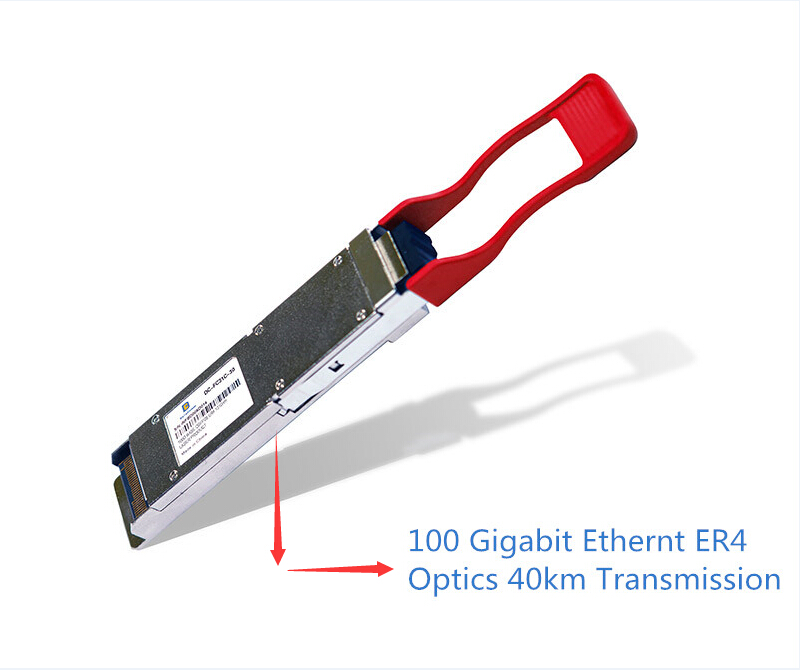
100G QSFP28 ER4 Lite
How Does It Develop?
A heated topic—how to reach beyond 10km in 100G network aroused much attention in Reddit. For applications beyond 10km, 100GBASE-ER4 is proposed. This type of optical transceivers are manufactured by using a semiconductor amplifier (SOA) inside the transceiver to increase power budget. However, 100G ER4 is available in CFP and CFP2 form factors, but because of the large form factor and power consumption, they are seldom utilized in 100G long-reach applications. What’s worst, the newly launched 100G optical switches are commonly equipped with compact QSFP28 ports instead of larger CFP interface.
These extended reaches are preferring to use high-density 100G QSFP28 modules to maximum capacity and minimize space, power usage and maintenance cost. The CWDM4 MSA defined the first duplex low-cost 100G specification for 2km reaches based on a CWDM grid and using RS (528,514) FEC. Now the 4WDM MSA is extending the value proposition of the CWDM4 MSA and RS-FEC to define an even more cost-effective set of specifications for reaches from 10 to 40 km. Customers, particularly hyperscale cloud service providers and carriers, are looking for optimized solutions for up to 40 km.
What’s New with QSFP28 ER4-Lite Solution?
QSFP-100G-ER4L-S is designed for extended reach 100 Gigabit Ethernet link. The 100GBASE-ER4-Lite QSFP28 supports both 100GbE and OTU4 applications over single-mode fibers, and supports up to 40km with FEC and up to 30km without FEC. 100G QSFP28 ER4 Lite module consumes 4.5W power in max.
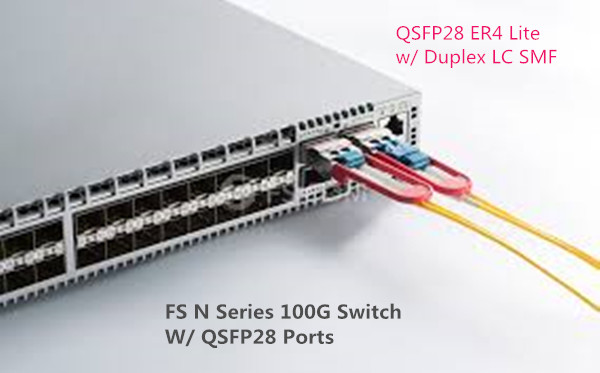
QSFP28 optics in 100G optical switch
The 100 Gigabit Ethernet signal is carried over four independent channels over four LAN-WDM wavelengths—1296nm, 1300nm, 1305nm, 1309nm. Multiplexing and demultiplexing of the four wavelengths are managed within the device. This QSFP28 was standardized by ITU-T as G.959.1 4L1-9D1F and 4-Wavelength WDM MSA Group. The following table displays the existing 100G QSFP28 MSA optics in detail.
ProductDescriptionConnector Type
QSFP-100G-SR4-S100GBASE SR4 QSFP Transceiver, 100m over OM4 MMFMPO-12 (12 fibers)
QSFP-100G-LR4-S100GBASE LR4 QSFP Transceiver, 0km over SMFLC
QSFP-100G-CWDM4-S100GBASE CWDM4 QSFP Transceiver, 2km over SMFLC
QSFP-100G-PSM4-S100GBASE PSM4 QSFP Transceiver, 500m over SMFMPO-12 (12 fibers)
QSFP-100G-ER4L-S100GBASE ER4 Lite QSFP Transceiver, 25-40km over SMFLC
The 100G QSFP ER4-Lite module will interoperate with existing ER4 solutions in the field up to 30km. Foe example, QSFP100 ER4-Lite provides backward compatibility with Cisco’s CPAK ER4-Lite, whose reach is up to 25km, and with IEEE 100GBASE-ER4 standardized transceivers, such as CFP 100G ER4, up to 30km. It also interoperates with QSFP28 and CPAK IEEE 100GBASE-LR4 modules up to 10km.
40km Transmission With FEC Turn On
To reach 40km transmission, QSFP ER4 lite requires the use of FEC on the host platform. So what is FEC? Forward Error Correction (FEC) can turn a mediocre to bad BER into a good BER. Ethernet network usually uses FEC in 1000BASE-PX (EPON), 10GBASE-KR, 10GEPON, 10GBASE-T, DSL, etc. High end long haul telecom industry also requires FEC. P802.3ba links have limited power budgets and SNR, for e.g. eye safety reasons.
Conclusion
The migration of current network infrastructure to 100G systems is inevitable, and a growing number of enterprises require 100G client interface to extend up to 40km without the use of expensive optical amplifiers. Thus, the new ER4-Lite specification enables cost-effective 100G 40km pluggable solutions in compact QSFP28 transceivers that use Forward Error Correction (FEC) and APD-based receivers. Such evolution is very exciting for not only everyone involved in its development and construction, but also for all those who seek a simple, reliable and cost-effective solution to extend the reach of their networks, without expensive network upgrades. FS.COM is devoting to change the world with our cost-effective self-developed devices, if you are interested, please feel free to contact us.

Thursday, August 11, 2016

Stay For 40Gbps Network or Scale Up to 100G?

The evolution of bandwidth for data transmission is unstoppable. From the 10Mbps, 100Mbps Ethernet to the 10G or 40/100G Ethernet, telecom manufacturers keep promoting higher internet speed to facilitate people’s daily life. Now, bandwidth speeds of 1Gbps to 10Gbps Ethernet capacity are commonly utilized around the world. However, with the increase in data center and cloud computing technologies, the demand for bandwidth speeds of 40G to 100G Ethernet is growing steadily for carriers and other data consumers.
Just like the dilemma of whether to use the fiber optic cable for high performance or adopt copper cable for the low cost, these high-end data consumers also have the doubt about 40G and 100G. Should we upgrade our capacity to 40Gbps or skip 40Gbpsand migrate directly to 100Gbps Ethernet? This article will help to draw an answer to this dilemma from the aspects of market trend for required bandwidth, cost and performance.
Upgrade Straight to 100G
According to today’s market trend, the tendency is to skip 40Gbps. With demanding users peeling off multiple 10Gbps channels, the 40Gbps pipe becomes quickly utilized. Carriers scaling up to 100Gbps, allows greater flexibility for one’s network infrastructure utilizing multiplexing solutions to carve multiple bandwidth channels from a single pipe. On another scale, the same is true for the consumer market where capacity is increasing from 1Gbps to 10Gbps, skipping 2.5Gbps levels, due to the flexibility and scalability 10Gbps provides at a very similar cost. In many cases, carriers and consumers have decided to skip 40Gbps and acquire 100Gbps for the following reasons and benefits:
100G logo
  • Cost Efficiency—From a network equipment standpoint, often it may be more cost-efficient to upgrade a 10Gbps link to 100Gbps, versus 40Gbps. Essentially, if you should require 60Gbps or say even 80Gbps, additional cards would be needed to support the link in the chassis, whereas a customer may utilize only one card to achieve more than twice the bandwidth at 100Gbps. 100Gbps allows the network to operate within a smaller footprint of a data center, which in turn, reduces power consumption dissipating less heat and thus lower operational costs.
  • Lower Latency—100Gbps provides lower latency capabilities than 40Gbps; many carrier grade vendors are lowering latency on 100Gbps matching latency of traditional 10Gbps traffic.
  • Flexibility—Creates options to provide multiple variations of delivery with handoffs ranging from 10Gbps, 40Gbps or the full 100Gbps pipes.
  • Scalability—Although a customer may not utilize 100Gbps on day one, the ability is there to scale the network with no forklift upgrade at any point, future-proofing the solution well beyond capacity needs.
As consumer’s demands for higher bandwidth continues to rise, many equipment suppliers, who developed some of the first 100 Gigabit Ethernet Router Interfaces, are now working on developing 200Gbps, 400Gbps up to 1 Terabyte interfaces.
This article is not implying that there is no use for 40Gbqs bandwidth level technology. Instead, I suggest that many end consumers are looking to keep up with the acceleration of high bandwidth demands while maintaining the efficiency and technologies needed to support their network infrastructure requirements while reducing operating costs.
100G Optic Solutions
FS.COM 100G transceiver solution offers customers 100 Gigabit Ethernet connectivity options for data center networking, enterprise core aggregation, and service provider transport applications. Various of 100G transceivers including CXP, CFP, CFP2, CFP4 and QSFP28 are available for different applications. The following part will lists two cost-effective 100G solutions.
  • QSFP28 to QSFP28 Interconnection
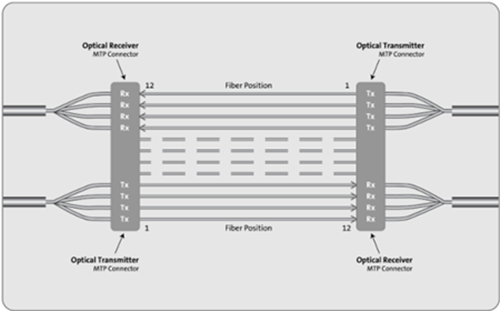
The QSFP28 is the exact same footprint as the 40G QSFP+, but is implemented with four 25Gbps lanes. To interconnect a multimode QSFP28 link, a 12-fiber MPO/MTP patch cable is required, while for single-mode link (100GBASE-LR4 QSFP28), a duplex LC single-mode patch cable is required. The interconnection of QSFP28 multimode link is similar with the case of QSFP28-100G-SR4 see in the following figure.
100G solution
  • CXP/CFP to CXP/CFP Interconnection
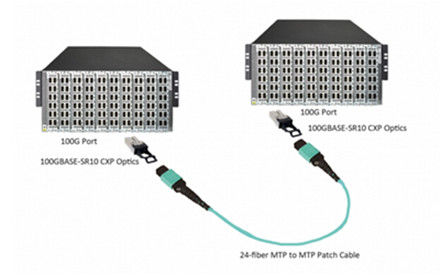
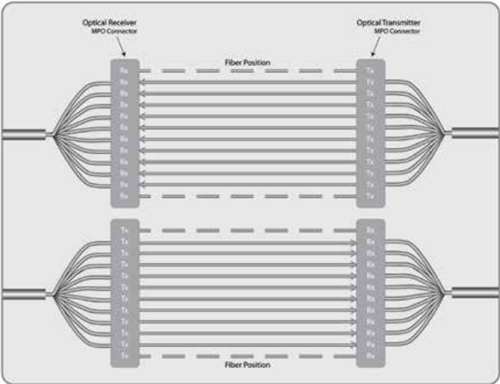
FS.COM’s 24-fiber MPO/MTP assemblies are ideal for 100GBASE-SR10 CXP/CFP to CXP/CFP interconnection in data center, since it is implemented 10 lanes of 10 Gbps. Among the 24 fibers, only 20 fibers in the middle of the connector are used to transmit and receive at 10 Gbps and the 2 top and bottom fibers on the left and right are unused. The following picture shows the interconnection between two 100GBASE-SR10 CXP ports.
CFP to CFP Interconnection
FS.COM provides a full selection of 100G optics including CFP, CFP2, CFP4, QSFP28 (QSFP28-100G-SR4) and QSFP28 DAC cables just as listed above. All of our products are fully compatible with the original brand. In addition, our 100G transceivers offer significant advantages over existing solutions in terms of reduced power dissipation and increased density with the added benefit of pluggability for reduced first installed cost. If you have any requirement, you can send your request to us.

Thursday, May 19, 2016

Are You Ready for Embracing 100G Ethernet?

Ethernet as the networking standards, enables computers to locally connect to each other, which is the ultra-strong backbone to the many networks we use every day. Although most of the Ethernet market is still running around 1 Gbqs or 10 Gbqs, there is a strong interest in higher data rates. Many hardware vendors like Cisco, Finisar, Huawei and Brocade have recently announced support for 100 Gigabit Ethernet and telecom vendors around the world have also shown interest in launching 100G networks. All these events shows the sign of the advent of 100 Gigabit Ethernet in the commercial segment. However, is it necessary to move to 100G now? Or should the 100g migration be a smooth one just as the IEEE has made when moving to 40G? This article will highlight the reasons and solutions of upgrading to 100G.
100G etherent
Why Move to 100G?
  • Most enterprises today are encouraging telecommuting and promote real-time, high-definition, high-quality voice and video solutions. All these require a huge bandwidth capacity. Additionally, 100G implementations offer an effective means to operate seamlessly within an existing 10G network infrastructure, avoid the need for additional optical amplifiers, dispersion compensators or regenerators. 100G is today’s choice to scale networks in a way that delivers the required capacity in the most efficient manner, readying the network for tomorrow’s bandwidth crunch.
  • Another interesting point is the efficiency of 100G Ethernet compared to link aggregation that is used today. As of now, a 10 x 10G Ethernet link aggregation can not give a throughput of up to 100 Gbps. This limitation can be overcome with a true 100G connection which can give a 100Gbps bandwidth, thus allowing high capacity links to scale even further. Considering all these, if not this year or the next, 100G will be widely adopted soon.
  • Last but not the least, the industry have come together in order to create a healthy 100G ecosystem, which will be beneficial for the entire community. This broad inclusion will result in a fast introduction of 100G solutions that will meet industry performance, size, cost, and power requirements. If the cost drive is right, once 100G is standardized and commercially available, network operators will quickly capitalize 40G investments and adopt 100G transmission for their future deployments.
Migrate to 100G with 100G Transceiver Modules
There are several form factors for supporting 100GbE including CFP, CFP2, CFP4, QSFP28 and CPAK. The following will make a clear introduction to all of them.
CFP Transceiver
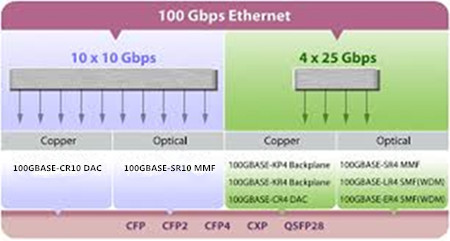
The CFP is the very first 100G transceiver for the transmission of high-speed digital signals, the C stands for the Latin letter centum (means 100). The CFP module was designed after the SFP interface, but is significantly larger to support 100 Gbqs using 10 x 10 Gbit/s lanes in each direction (RX, TX). The optical connection can support both 10 x 10 Gbit/s and 4 x 25 Gbit/s variants of 100 Gbit/s interconnects. There are four common types of CFP transceiver modules, such as 100GBASE-SR10 in 100 meter MMF, 100GBASE-LR10 and 100GBASE-LR4 in 10 km SMF reach, and 100GBASE-ER10 and 100GBASE-ER4 in 40 km SMF reach respectively.
CFP module
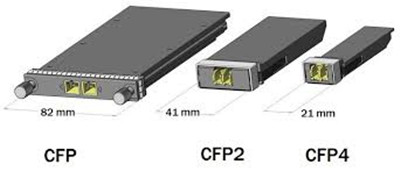
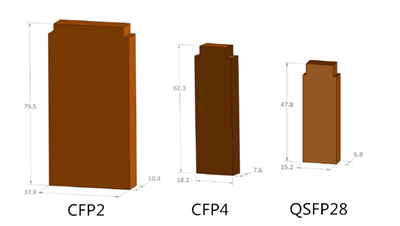
As improvements in technology have allowed higher performance and higher density, which drives the development of the CFP2 and CFP4 specifications. While CFP, CFP2 and CFP4 are electrical similar, they specify a form-factor of 1/2 and 1/4 respectively in size of the original specification. Note that CFP, CFP2 and CFP4 modules are not interchangeable, but would be inter-operable at the optical interface with appropriate connectors.
QSFP28 Transceiver
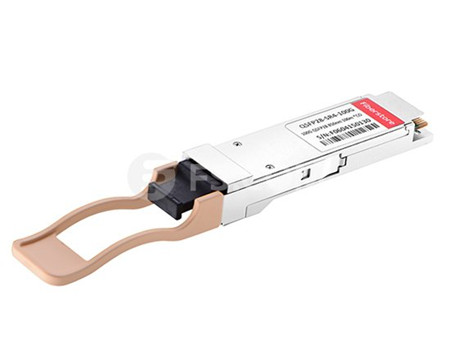
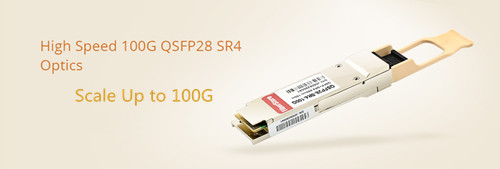
QSFP28 is the same footprint as the 40G QSFP+ module. Just as the 40G QSFP+ module is using four 10Gbps lanes, the 100G QSFP28 is implemented with four 25Gbps lanes. In all QSFP versions, both the electrical lanes and the optical lanes operate at the same speed, eliminating the costly gearbox found in CFP, CFP2, and the CPAK. The QSFP28 module has an upgraded electrical interface to support signaling up to 28Gbps signals, yet keeps all of the physical dimensions of its predecessor. As QSFP28 technology becomes even maturer, QSFP28 transceivers will become more and more popular in 100G optics market. The above image shows a QSFP-100G-SR4-S. it is Cisco 100GBASE-SR4 QSFP28 transceiver module.
QSFP-100G-SR4-S
100GBASE-SR4 QSFP28 transceiver and 100GBASE-LR4 QSFP28 transceiver are the two main types of the QSFP28 transceivers. The former is specified to operate over multimode fiber (MMF) with the maximum link length of 70m on OM3 and 100m on OM4, while 100GBASE-LR4 QSFP28 is standardized to work through single-mode fiber (SMF), able to realize 10km link length.
QSFP28 vs. CFP
QSFP28 and CFP are the two common 100G optical transceivers available on the market. As noted before, CFP is the first-generation 100G transceiver. It is the common scene that QSFP28 makes an appearance and CFP takes a bow, which reflects the trend in the industry to aggressively bring 100GE density up and costs down. CFP4 is half the width of CFP2, which is half again the width of CFP. QSFP28 has the same footprint and faceplate density as QSFP+ and is just slightly smaller than CFP4. Theoretically, QSFP28 seems to have the density advantage over CFP4, but CFP4’s higher maximum power consumption gives it the advantage on longer reach optical distances. However, the CFP is much more expensive than QSFP28 and will not be used for lower speeds because of the high cost.
100G-modules
CPAK Transceiver
CPAK is another newcomer to supporting 100G network. This is a proprietary form factor from Cisco but the interfaces demonstrated are IEEE standards and will interoperate with the same interfaces supported by other form-factors. Together, these solutions will deliver the smallest form-factor, most efficient 100-Gbps optical transceiver portfolio in the industry. Cisco CPAK will be available in several IEEE-standard optical interfaces.
Conclusion
Within the next several years, 100G is doom to become the dominant backbone technology in terms of its high capacity over 10G and surpassing would-be high-speed contender 40G. Of course, we must count on the components and systems suppliers to build products that meet technical and economic requirements while allowing a smooth migration to the 100G infrastructure that is being put in operation today. Fiberstore as a rising telecom supplier, is committed to promote telecommunication development. We recently release a full range of 100G optical transceivers including CFP, CFP2, CFP4, QSFP28 and QSFP28 DAC cables. All of our products are fully compatible with the original brand. If you have any requirement, you can send your request to us.

Wednesday, March 16, 2016

Upcoming 40/100G Technology

The past decades witnessed the tremendous advancement in Ethernet network transmission speeds from 10/100 base systems to 1G then 10G deployments. Today, 10G server uplinks are ubiquitous in the data center, driven by the need for higher bandwidth, 40/100G server uplinks are just around the corner. IEEE ratified 40/100G Ethernet Standard in June 2010. Since then people were hoping to embracing this new Gigabit Ethernet. However, migrating to higher data rates seems not be that easy. This article will pay special attention to those aspects that influence the migration path.
New Transceiver Interface: MPO Connector
When transition to 40/100G, parallel optics are needed to transmit and receive signals. Because for 40G, there are 4-Tx and 4-Rx fibers, each transmitting at 10G for an aggregate signal of 40G. And for 100G, there are 10-Tx and 10-Rx. As parallel optics technology requires data transmission across multiple fibers simultaneously, a multifiber (or array) connector is required. Defined by TIA-604- 5-C, Fiber Optic Connector Intermateability Standard, MPO (FOCIS-5) is an array connector that can support up to 72 optical fiber connections in a single connection and ferrule. Factory-terminated MPO solutions allow connectivity to be achieved through a simple plug and play system. And this MPO-terminated backbone/horizontal cabling is simply installed into preterminated modules, panels, or Harnesses.
40G Ethernet Solution
According to IEEE 802.3ba, 40G was designated to support high-performance computing clusters, blade servers, SANs and network-attached storage. When deploying 40G network, QSFP transceiver and a 12-fiber MPO will be utilized. Deployment of 40G over multimode fiber will be achieved with 4-Tx and 4-Rx fibers from the 12-fiber MPO. The fibers will be the outer fibers as shown in Figure 3. Each of these four “channels” will transmit 10G for the combined 40G transmission. While single-mode fiber transmission will remain duplex connectivity using course wavelength division multiplexing. Some transmission media for 40G are to be included in the following table.
40G
  • 40 GBASE-SR4 (parallel optics)
—100m on OM3/125m on OM4, 10G on four fibers per direction
  • 40 GBASE-LR4 course wavelength division multiplexing (cWDM)
—10km on single-mode fiber, 4x 10G 1300 nm wavelength region like QSFP-40GE-LR4
  • 40 GBASE-CR4
—7 m over copper, 4 x 10G (twinax copper)
100G Ethernet Solution
40G is to support increasing bandwidth demand for server computing, while 100G was designated to support switching, routing and aggregation in the core network. For 100G deployments, the CXP will be the electronics interface for OM3/OM4 multimode fiber, while CFP will be the interface for single-mode fiber. For 100G transmission over multimode fiber, the optical connector interface will be the 24-fiber MPO connector that will support 10-Tx and 10-Rx channels, each transmitting at 10G. Transmission over single-mode will be achieved via wavelength division multiplexing with duplex connectivity.
100G
  • 100 GBASE-SR10 (parallel optics)
—100m on OM3 or 125m on OM4, 10G on 10 fibers per direction
  • 100 GBASE-LR4 (dWDM)
—10km on single-mode, 4 x 25G 1300 nm
  • 100 GBASE-ER4 (dWDM)
—40km on single-mode, 4 x 25G 1300 nm
  • 100 GBASE-CR10
—7 m over copper, 10 x 10G (twinax copper)
Cabling Migration From 10G to 40G to 100G in an MPO-based System
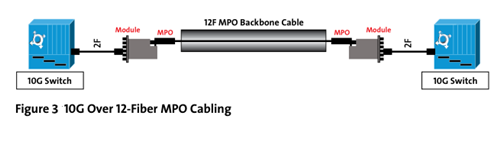
Starting with 10G, a 12-fiber MPO cable is deployed between the two 10G switches. Modules are used at the end to transition from the 12-fiber MPO to LC duplex. This enables connectivity into the switch (Figure 3).
10G over 12-Fiber MPO Cabling
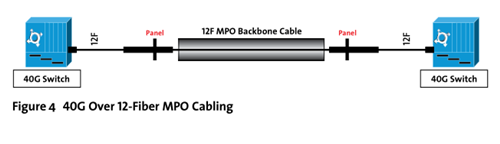
For 12-fiber MPO cassette-based optical systems already installed, 40G migration is as simple as replacing the existing cassette from the patch panel housings at the equipment and cross connects with an MPO adapter panel. The use of a 12-fiber MPO jumper is needed to establish connectivity between the switches (Figure 4).
40G over 12-Fiber MPO Cabling
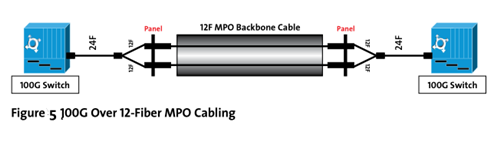
Future 100G networks will require a 24-fiber MPO jumper to establish a link. Systems that use 12-fiber MPO backbone cabling will need a 24-fiber to two 12-fiber MPO jumpers (Figure 5).
100G over 12-Fiber MPO Cabling
Future Proofing
As we transition to 40G and 100G, an MPO-based trunk with appropriate fiber can be installed, which will provide an easy migration path to future higher-speed technology. This article has mentioned some optical devices and cabling solutions to support 40/100G Ethernet. Fiberstore provides a large amount of 40/100G equipment like 40G QSFP+ (JG661A), 40G DAC and AOC, etc. CFP, CFP2, CFP4 and QSFP28 are also offered with very competitive prices and high quality. To best meet the needs of the future, future proofing is crucial. So if you have any requirement of our products, please send your inquiry to us.