Showing posts with label FTL410QE2C. Show all posts

Thursday, March 24, 2016

Choose 12-fiber or 24-fiber for 40/100G Migration

There is no doubt that 40 and 100 GbE are just around the corner, or the reality is coming. To keep up with the pace, data center managers are striving to determine which fiber optic links will support 10 GbE today while future proofing the best, most effective migration path to 40 and 100 GbE. Many network designers recommend that the use of 12-fiber multimode trunk cables can provide the best migration path to 40 and 100 GbE. While others confirm that 24-fiber trunk cables with 24-fiber MPOs on both ends is a better standards-based transition path. So which one is the most suitable solution? It all comes down to a brief comparison of these two cables over investment and reduced future operating and capital expense.
24-fiber Solution
The use of 24-fiber trunk cables between switch panels and equipment is a common-sense approach, but people may not be familiar with this optic scenario. In fact, a 24-fiber trunk cable is used to connect from the back of the switch panel to the equipment distribution area. For 10 GbE applications, each of the 24 fibers can be used to transmit 10 Gbps, for a total of 12 links. For 40 GbE applications, which requires 8 fibers (4 transmitting and 4 receiving), a 24-fiber trunk cable provides a total of three 40 GbE links. For 100 GbE, which requires 20 fibers (10 transmitting and 10 receiving), a 24-fiber trunk cable provides a single 100 GbE link as shown in Figure 1.
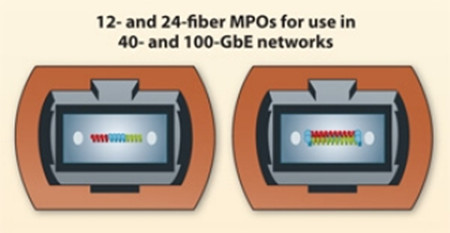
12-fibers
Maximum Fiber Utilization
As noted before, 40 GbE uses eight fibers of a 12-fiber MPO connector, leaving four fibers unused. When using a 12-fiber trunk cable, three 40 GbE links using three separate 12-fiber trunk cables would result in a total of 12 unused fibers, or four fibers unused for each trunk. But with the use of 24-fiber trunk cables, data center managers actually get to use all the fiber and leverage their complete investment. Running three 40 GbE links over a single 24-fiber trunk cable uses all 24 fibers of the trunk cable. Obviously, 24-fiber is more appropriate for 40/100G migration.
Increased Fiber Density
Because 24-fiber MPO connectors offer a small footprint, they can ultimately provide increased density in fiber panels at the switch location. With today’s large core switches occupying upwards of 1/3 of an entire rack, density in fiber switch panels is critical. Hydra cables feature a single 24-fiber MPO connector on one end and either 12 duplex LC connectors on the other end for 10 GbE applications, 12-fiber MPO connectors for 40 GbE or a 24-fiber MPO connector for 100 GbE. With a single 1RU fiber panel able to provide a total of 32 MPO adaptors, the density for 10 GbE applications is 384 ports in a 1RU (duplex LC connectors) and 96 40 GbE ports in a 1 RU (12-fiber MPOs). Figure 2 shows a 12-fiber MTP trunk cable with MTP/APC connector on both ends largely improves the performance for 40G/100G fiber links.
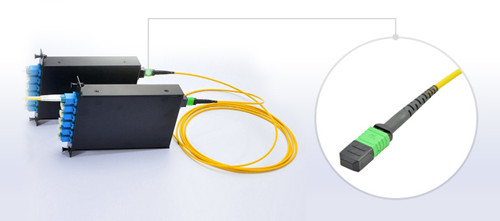
mtp-jumper-cable
Reduced Cable Congestion
Cable congestion is one of the biggest problems in the data center because it will make cable management more difficult and impede proper airflow needed to maintain efficient cooling and subsequent energy efficiency. In fact, a 24-fiber trunk cable are only appreciably larger than 12-fiber trunk cables in diameter. That means the 24-fiber trunk cables provide twice the amount of fiber in less than 21% more space. For a 40 GbE application, it takes three 12-fiber trunk cables to provide the same number of links as a single 24-fiber trunk cable—or about 1-1/2 times more pathway space.
Cost-effective Migration Path
As 24-fiber trunk cables can effectively support all three applications shown in Figure 3, there is no need to recable the pathways from the back of the switch panel to the equipment distribution area. That means that data center managers can easily migrate to higher speeds with all of that cabling remains permanent and untouched. With 24-fiber trunk cables offer guaranteed performance for 10, 40 and 100 GbE, upgrading the cabling infrastructure is as simple as upgrading the hydra cables or cassettes and patch cords to the equipment.
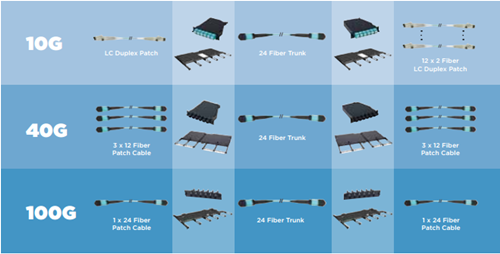
migration path from 10G to 40&100G
Conclusion
With guaranteed support for all three applications, the ability to use all the fiber deployed, reduced cable congestion and higher port density in fiber panels, and an easy migration scheme, 24-fiber trunk cables offers lower future capital and operating expense. Fiberstore supplies 12, 24, 48, 72, 96 and 144 fiber core constructions with OM1, OM2, OM3 or OM4 fiber trunk cable, these trunk cable assemblies are composed of high quality LSZH jacketed fiber optic cables, connecting equipment in racks to MTP/MPO backbone cables. 40G QSFP+ optical transceivers like FTL410QE2C and QSFP-40G-LR4-S are also provided. If you are interested in any of our products, please contact us directly.

Tuesday, February 16, 2016

40-Gbps Parallel and Bidirectional Transceiver

With speed in data center changing from 10- to 40-Gbps and eventually to 100-Gbps, mobile and virtualized workloads, cloud applications, big data and heterogeneous devices are all demanding previously unimagined capacity and performance from servers and data center fabric. High-capacity optical technology and cabling infrastructure are required to support those servers and applications for 40-Gbps upgrading. Today’s article will mainly introduce pluggable optical Enhanced Quad Small Form-Factor Pluggable (QSFP+) modules, especially Bidirectional and parallel QSFP+ transceivers.
Brief Introduction to Optical Transceiver
The transceiver is an electronic device comprising both a transmitter and a receiver in the same circuity. This optical transceiver receives an electrical signal, converts it into a light signal, and launches the signal into a fiber. It also receives the light signal, from another transceiver, and converts it into an electrical signal. It is commonly known as GBIC, SFP, SFP+, XFP, CFP and QSFP+. The QSFP+ transceiver is the dominant transceiver form factor used for 40 Gigabit Ethernet applications. In 2010 the IEEE standard 802.3ba released several 40-Gbps based solutions, including a 40GBASE-SR4 parallel optics solution for MMF (FTL410QE2C is compatible Finisar 40GBASE-SR4 QSFP+ MMF transceiver with a link length of 150m). Since then, several engineered solutions have been released, including 40GBASE-CSR4, which is similar to 40GBASE-SR4 but extends the distance capabilities. Another solution is a bidirectional 40-Gbps transceiver that uses a two-fiber LC optical interface.
Comparison of 40GBASE-SR4 Parallel Transceiver and Bidirectional Optical Transceivers 
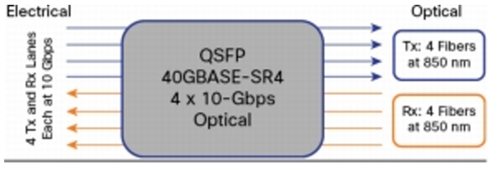
Parallel optical transceivers differ from traditional fiber optic transceivers in data center is simultaneously transmitted and received over multiple fibers. Used for 40GBASE-SR4 and 40GBASE-CSR4, this transceiver has 10-Gbps electrical lanes that are mirrored in the optical outputs and thus require eight fibers with an MTP connector interface. Each fiber either transmits (Tx) or receives (Rx) 10-Gbps traffic at a single wavelength. Figure 1 shows the electrical and optical lanes diagram of 40GBASE-SR4 QSFP+ transceiver.
40GBASE-SR4 transceiver electical and optical interface
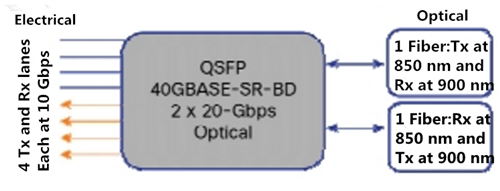
Bidirectional optical transceivers used for 40GBASE-SR-BD have the same 10-Gbps electrical lanes, which are then combined in the optical outputs, thus requiring two fibers with an LC connector interface. Each fiber simultaneously transmits and receives 20-Gbps traffic at two different wavelengths. Figure 2 shows a electrical and optical lanes diagram of bidirectional optical transceiver.
Bidirectional optical transceiver electical and optical interface
From the above images, we can easily see some differences between Bidirectional and parallel optical transceiver. This two-fiber 40-Gbps Bidirectional (BiDi) multimode solution uses two different transmission windows (850 nm and 900 nm) that are transmitted bidirectionally over the same fiber, which will allow the use of same cabling infrastructure for 40 Gigabit Ethernet as was used for 1 and 10G Ethernet application. While the parallel multimode optical transceiver operates at a wavelength of 850nm. In additional, the connector type was converted from the traditional 2-fiber LC duplex connector to a 12-fiber MTP connector.
Cabling Options for Parallel and Bidirectional Optical Modules
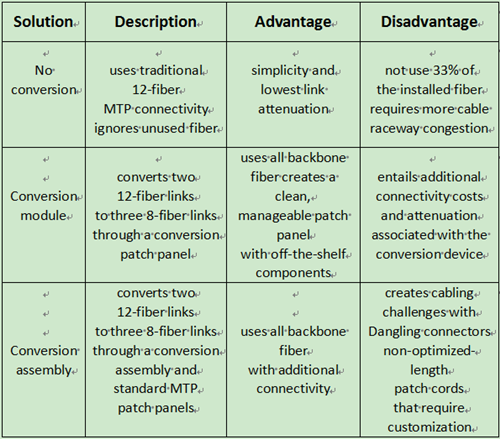
Choosing which type of fiber optical cable for your infrastructure is essential. As noted before, 40GBASE-SR4 multimode parallel optical transceiver uses eight fibers to transmit four duplex channels each at 10 Gigabit Ethernet. Parallel optical transceiver uses MTP 12-fiber trunk cable but only 8 of 12 fibers is used. There are several basic cabling options for parallel optics connectivity. I will generally introduce three solutions to you. One approach is to ignore the unused fibers and continue to deploy 12 fibers. Another approach is to use a conversion device to convert two 12-fiber links into three 8-fiber links. Figure 3 summarizes these three cabling solutions for 40G connectivity.
three cabling solutions for 40G connectivity.
As for the pluggable Bidirectional transceiver, it has the same QSFP+ format as the existing 40GBASE-SR4 transceiver. Therefore, the same switch line card with QSFP+ ports can support either parallel optics 40GBASE-SR4 or bidirectional optics 40GBASE-SR-BD solutions. Thus, when directly connecting a 40 Gigabit Ethernet bidirectional transceiver to another bidirectional transceiver, a Type A-to-B standard LC duplex patch cord can be used. This reverse fiber positioning allows a signal to be directed from the transmit position on one end of the network to the receive position on the other end of the network. However, this type of direct connectivity is suggested only within a given row of cabinets.
Conclusion
40-Gbps performance is no longer a myth, but a truth that has already facilitated people's daily life. When transitioning from 10 to 40 Gigabit Ethernet, extended 40 Gigabit Ethernet link distances, which match the distances at 10 Gigabit Ethernet, can be achieved by parallel optics transceivers. And as to 40 Gigabit Ethernet bidirectional transceivers, no changes to the cabling infrastructure are required, which is a huge cost saving. Fiberstore offers a large variety of 40-Gbps parallel optical transceivers that are fully compatible with major brand like Finisar QSFP+. For more detailed information about our devices, please contact us directly.