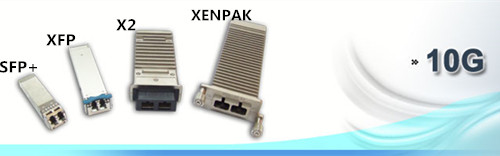
The widely acknowledged Ethernet speed upgrade path was 10G-40G-100G. However, a new development indicates the latest path for server connection will be 10G-25G-100G with potential for future upgrading to 400G. But why 25G? Because moving from 10G to 40G is a big jump and it turns out the incremental cost of 25G silicon over 10G is not that great. This new standard will require improved cables and transceiver modules capable of handling this additional bandwidth, under this circumstance, QSFP28 and SFP28 are promoted.
25GbE Ethernet—An Emerging Standard
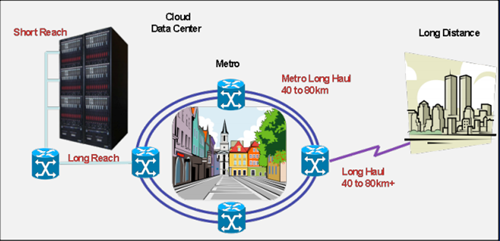
25 Gigabit Ethernet (25GbE) has passed the first hurdle in the IEEE standards body with a successful Call for Interest (CFI) in July, 2014. It is a proposed standard for Ethernet connectivity that will benefit cloud and enterprise data center environments. 25GbE leverages technology defined for 100 Gigabit Ethernet implemented as four 25-Gbit/s lanes (IEEE 802.3bj) running on four fibers or copper pairs. The follow picture shows 25G Access Network.
25 Gigabit Ethernet (25GbE) has passed the first hurdle in the IEEE standards body with a successful Call for Interest (CFI) in July, 2014. It is a proposed standard for Ethernet connectivity that will benefit cloud and enterprise data center environments. 25GbE leverages technology defined for 100 Gigabit Ethernet implemented as four 25-Gbit/s lanes (IEEE 802.3bj) running on four fibers or copper pairs. The follow picture shows 25G Access Network.
Significant Performance Benefits—25G Over 40G
The value of 25GbE technology is clear in comparison to the existing 40GbE standard. Obviously, 25GbE technology provides greater port density and a lower cost per unit of bandwidth for rack server connectivity. For applications that demand substantially higher throughputs to the endpoint, there exists 50GbE—using only two lanes instead of four—as a superior alternative to 40GbE in both link performance and physical lane efficiency.
The value of 25GbE technology is clear in comparison to the existing 40GbE standard. Obviously, 25GbE technology provides greater port density and a lower cost per unit of bandwidth for rack server connectivity. For applications that demand substantially higher throughputs to the endpoint, there exists 50GbE—using only two lanes instead of four—as a superior alternative to 40GbE in both link performance and physical lane efficiency.
The proposed 25GbE standard delivers 2.5 times more performance per SerDes lane using twinax copper wire than that available over existing 10G and 40G connections. A 50GbE link using two switch/NIC SerDes lanes running at 25 Gb/s each delivers 25% more bandwidth than a 40GbE link while needing just half the number (four) of twinax copper pairs. Therefore, a 25GbE link using a single switch/NIC SerDes lane provides 2.5 times the bandwidth of a 10GbE link over the same number of twinax copper pairs are used in today’s SFP+ direct-attach copper (DAC) cables.
Perhaps the most important benefit of 25GbE technology to data-center operators is maximizing bandwidth and port density within the space constraints of a small 1U front panel. It also leverages single-lane 25Gb/s physical layer technology developed to support 100GbE.
Cloud Will Drive to QSFP28 and SFP28
QSFP28 is used for 4x25GE and SFP28 is used for a single 25GE port. SFP28 module, based on the SFP+ form-factor, suports the emeraging 25G Ethernet standard. It enables error-free transmission of 25Gb/s over 100m of OM4 multi-mode fiber and a new generation of high-density 25 Gigabit Ethernet switches and network interface cards, facilitating server connectivity in data centres, and a conventional and cost-effective upgrade path for enterprises deploying 10 Gigabit Ethernet links today in the ubiquitous SFP+ form factor.
QSFP28 is used for 4x25GE and SFP28 is used for a single 25GE port. SFP28 module, based on the SFP+ form-factor, suports the emeraging 25G Ethernet standard. It enables error-free transmission of 25Gb/s over 100m of OM4 multi-mode fiber and a new generation of high-density 25 Gigabit Ethernet switches and network interface cards, facilitating server connectivity in data centres, and a conventional and cost-effective upgrade path for enterprises deploying 10 Gigabit Ethernet links today in the ubiquitous SFP+ form factor.
The QSFP28 (25G Quad Small Form-Factor Pluggable) transceiver and interconnect cable is a high-density, high-speed product soluon designed for applicaons in the telecommunicaons, data center and networking markets. The interconnect offers four channels of high-speed signals with data rates ranging from 25 Gbps up to potentially 40 Gbps, and will meet 100 Gbps Ethernet (4x25 Gbps) and 100 Gbps 4X InfiniBand Enhanced Data Rate (EDR) requirements.
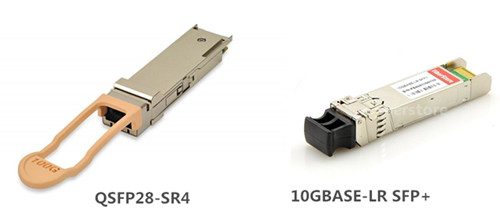
The demonstration showed QSFP28-SR4 modules and a compatible Finisar FTLX1471D3BCL 10GBASE-LR SFP+. The QSFP28 SR4 module is a vertically integrated solution that meets IEEE 802.3 standards and MSA requirements with power dissipation well under 3.5W. The module supports both 100GBASE-SR4 as well as 4x25G breakout applications. Both the QSFP28 SR4 and SFP28-SR modules are sampling now.
Conclusion
The dominant next-generation server connection speed is going to be 25G as it providing a cost competitive longer reach option for mainstream customers. Fiberstore is excited to introduce several products that will drive the next generation of data centre and enterprise interconnects. We currently do not supply 100G QSFP28 and 25G SFP28 based switches, but we do manufacture a full range of tranceivers, such as SFP+, X2, XENPAK, XFP, SFP, GBIC, CWDM/DWDM, 40G QSFP+ & CFP, etc. Compatible Finisar FTLX1471D3BCL and FTLF8524P2BNL are offered with minimum price and high quality. If you are interested, please feel free to contact us.
The dominant next-generation server connection speed is going to be 25G as it providing a cost competitive longer reach option for mainstream customers. Fiberstore is excited to introduce several products that will drive the next generation of data centre and enterprise interconnects. We currently do not supply 100G QSFP28 and 25G SFP28 based switches, but we do manufacture a full range of tranceivers, such as SFP+, X2, XENPAK, XFP, SFP, GBIC, CWDM/DWDM, 40G QSFP+ & CFP, etc. Compatible Finisar FTLX1471D3BCL and FTLF8524P2BNL are offered with minimum price and high quality. If you are interested, please feel free to contact us.